 EN
EN

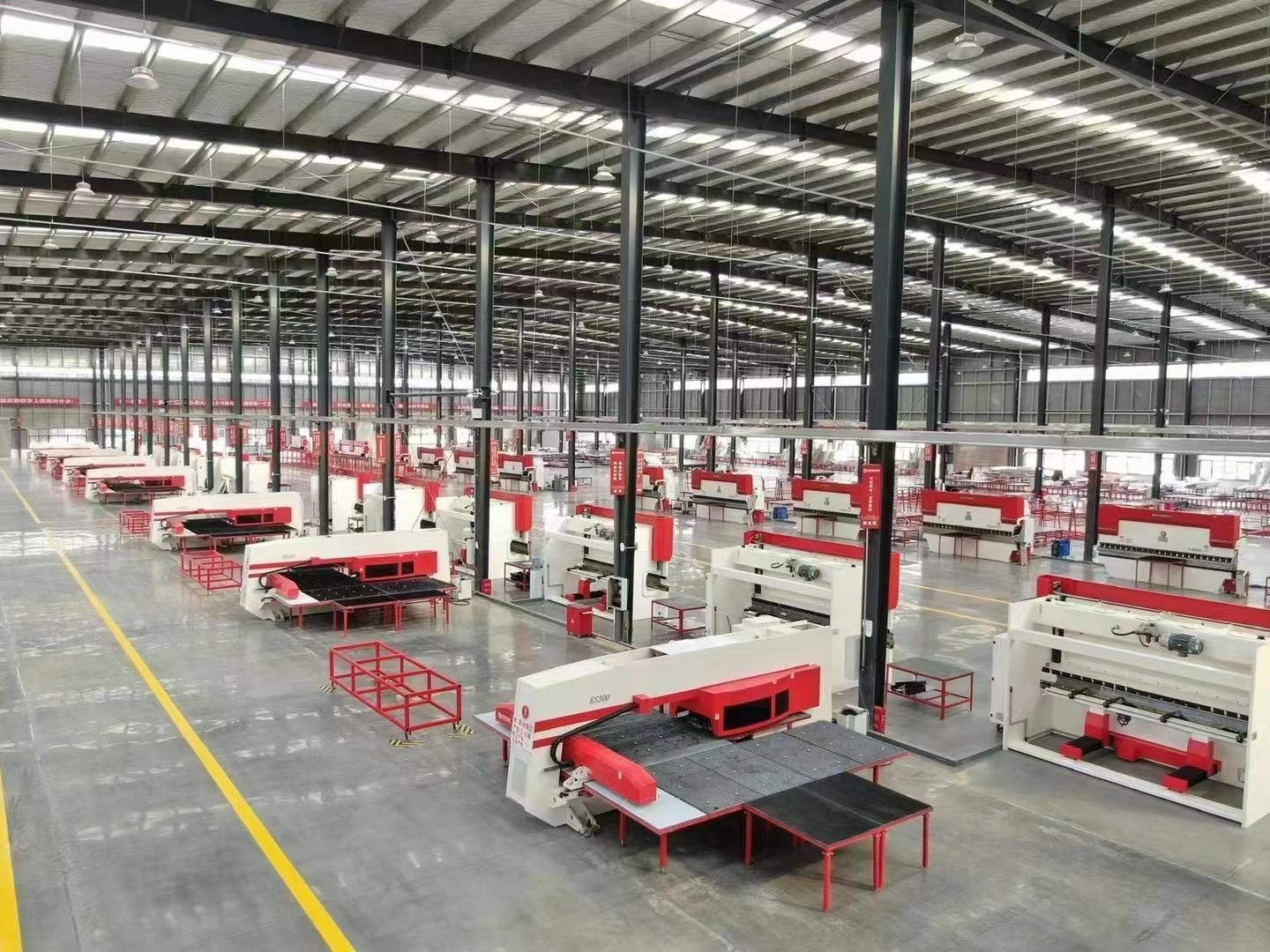
July 2026 — Electrical cabinet manufacturing is one of the highest-volume applications in sheet metal fabrication. Every distribution box, server rack, control panel, and outdoor enclosure starts as a flat sheet that needs hundreds of precisely positioned holes, louvers, knockouts, and formed features.
Get the punching strategy wrong, and you are looking at burred edges, misaligned mounting holes, excessive scrap, and production bottlenecks that ripple through your entire assembly line.
Get it right, and a single CNC turret punch press can replace three conventional machines while cutting per-part cost by 40%.
This guide covers everything a cabinet manufacturer needs to know — from choosing the right machine specifications to optimizing tooling setups for the most common enclosure features.
1. Why Turret Punching Beats Laser Cutting for Electrical Enclosures
The first decision most cabinet fabricators face is: should we punch or laser cut?
The answer depends on volume, feature type, and material — but for the vast majority of electrical enclosure work, turret punching wins decisively. Here is why.
Speed: Punching Is an Order of Magnitude Faster
A modern servo-driven CNC turret punch press can deliver 600-1,800 hits per minute. A typical electrical enclosure panel requires 80-200 holes of varying sizes. At 800 HPM, that panel is complete in under 15 seconds of punching time.
A fiber laser cutting the same panel with the same hole count would take 3-8 minutes — 12x to 32x slower. In a production environment running 200 panels per day, that difference translates to hours of machine time saved.
Cost: No Consumables, Lower Energy
No Heat-Affected Zone (HAZ)
Laser cutting introduces a heat-affected zone along every cut edge. For most enclosure work this is cosmetic. But for panels requiring precise flatness — such as mounting plates for sensitive electronics, or panels that will be powder-coated — even minor thermal warping causes downstream assembly problems.
Turret punching is a cold mechanical process. Zero thermal distortion, zero edge discoloration.
Louvers and Formed Features
This is the critical advantage for cabinet work. A CNC turret punch can produce louvers, knockouts, embosses, countersinks, hinges, and cable entry knockouts in the same setup — features that a laser simply cannot create.
For electrical enclosures, louvers are essential for ventilation. Forming them on a turret punch eliminates a secondary operation entirely.
When Laser Makes Sense
Laser has its place. Use it when:
- You need complex contour cutting (non-rectangular panel outlines)
- Material thickness exceeds 6 mm (above typical punching capacity)
- You are prototyping or running single-digit quantities where tooling setup cost outweighs speed
For production runs of 50+ identical electrical enclosure panels, turret punching is the clear winner.
2. Key Machine Specifications for Cabinet-Grade Punching
Not every turret punch press is optimized for enclosure work. Here are the specifications that matter most.
Punching Force: 30 Tons Is the Sweet Spot
Electrical enclosures are typically fabricated from 1.0-2.5 mm mild steel, galvanized steel, or stainless steel. A 30-ton (300 kN) machine handles this range comfortably.
Quick reference:
A 20-ton machine may struggle with stainless steel louvers at 2 mm. A 50-ton machine is overkill for enclosure work and costs significantly more.
Turret Stations: 32 Minimum, 40+ Recommended
Electrical enclosures require a diverse tool set: round punches from 3 mm to 50 mm, square and rectangular punches for connectors, louver tools, knockout tools, and forming tools.
More stations mean fewer tool changes between jobs. For a shop producing multiple enclosure models daily, the productivity gain from a 40-station turret over a 24-station turret can be 30-50%.
Auto-Index Stations: Essential for Cabinet Work
Auto-index stations can rotate tools to any angle under CNC control. For enclosure work, they are critical for:
- Corner knockouts at 45° angles
- Cable entry cutouts requiring multi-angle punching
- Oblong mounting slots at non-standard orientations
- Hinge cutouts with precise rotational alignment
Minimum recommendation: 2 auto-index stations. Ideal: 4 auto-index stations (one in each turret quadrant).
Sheet Size Capacity: At Least 1,250 x 2,500 mm
Standard enclosure panels come in sizes up to 1,200 x 2,400 mm. A machine with a 1,250 x 2,500 mm working area handles these without repositioning.
Look for machines with automatic repositioning capability — this allows processing panels up to 2,500 x 5,000 mm by automatically shifting the sheet and re-clamping.
Control System: FANUC or Siemens
The two dominant CNC controllers for turret punches are FANUC (Japanese) and Siemens (German). Both are reliable, but they differ in programming approach:
- FANUC: Macro-based programming, widely supported, large talent pool
- Siemens: More intuitive for complex forming sequences, better graphical interface
DARDON machines are available with both systems. For shops with existing FANUC-trained operators, sticking with FANUC eliminates retraining costs.
3. DARDON's Electrical Enclosure Solution Lineup
DARDON offers three turret punch press models specifically suited for electrical cabinet manufacturing. Here is how to choose between them.
ES300: Full Electric Servo — For Precision and Energy Efficiency
Best for: Shops producing high-mix, medium-volume enclosure work. The servo drive delivers exceptional energy efficiency — average power consumption of 4.5 kW/h versus 12-15 kW/h for hydraulic systems. The direct-drive transmission eliminates clutch and brake wear, dramatically reducing maintenance.
Key advantage for cabinets: The 4 auto-index stations allow complex louver patterns and multi-angle knockouts without manual tool rotation.
T30: Mechanical Flywheel — For High-Volume Standard Panels
Best for: High-volume production of standard enclosure panels. The mechanical drive system is the most battle-tested design in the turret punch industry. It trades speed for absolute reliability — simpler mechanics mean fewer failure points and easier maintenance.
Key advantage for cabinets: Proven reliability. Shops running the T30 report 5+ years of continuous production with only routine maintenance. The mechanical system handles thick galvanized steel (3-4 mm) without the thermal management issues of hydraulic systems.
ER300: Premium Full Electric Servo — For High-End Demanding Applications
Best for: Shops producing high-value, tight-tolerance electrical enclosures — server racks, medical equipment cabinets, telecom outdoor enclosures. The 40-station turret eliminates tool changes between job types. Remote machine diagnostics reduce service response time.
Key advantage for cabinets: The larger turret capacity handles the widest tool variety without changeovers. Remote support capability means a DARDON engineer can diagnose issues from Qingdao while your machine is running in Germany.