 EN

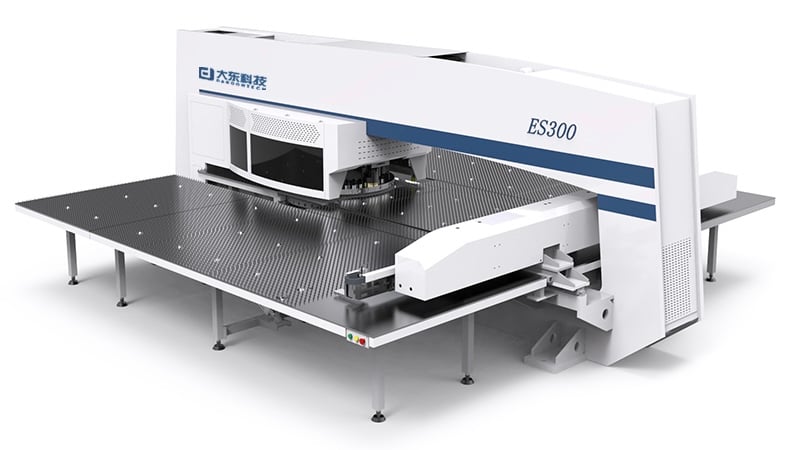
The Bottom Line: It Is Not About "Replacement"—It Is About "Process Coverage"
If your shop has already invested in a high-power fiber laser cutting machine, you might wonder if a CNC turret punch press is still necessary.
The answer is yes.
The fundamental reason is simple: A fiber laser modifies the two-dimensional planar geometry of a sheet, but it cannot alter the localized three-dimensional shape of the material.
Industry discussions often focus on horizontal parameters such as wattage, cutting speed, or positioning accuracy. However, those metrics only describe how efficiently a machine performs a specific task, not what it is fundamentally capable of doing. Comparing them on the same specification sheet confuses their purpose. Their underlying mechanisms are completely different: One separates material, while the other redistributes material.
Planar Contours Versus Three-Dimensional Forming Features
When examining a sheet metal drawing, the required features fall into two distinct categories:
-
Category 1: Two-Dimensional Contour Information
This includes outer profiles, irregular cutouts, slots, and standard process holes. This geometry exists purely in a single plane. A fiber laser accomplishes this easily using a concentrated beam of high-energy light. No hard tooling is required, and modifying a part only requires updating the CNC program. This flexibility explains why many modern fabrication shops purchase a laser first. -
Category 2: Three-Dimensional Shape and Forming Information
This includes louver angles for ventilation, countersunk holes for flush screw heads, stiffening ribs for structural rigidity, extruded flanges for thread engagement, and internal screw threads. These features require the metal to undergo localized plastic deformation or mechanical cutting. A laser beam traveling across a sheet leaves behind a cut kerf, but the material on both sides remains flat.
The Decision Rule:
Check part drawings for five specific features: protrusions, indentations, vertical flanges, countersinks, and threads. If orders consist exclusively of flat two-dimensional profiles, a laser is sufficient. Once any of these five features appear, you must have mechanical forming capabilities or outsource those operations.
This is why purchasing a laser first and adding a punch press later is a standard and practical equipment strategy in the sheet metal industry. The laser maximizes cutting speed and nesting flexibility, while the punch press provides essential structural forming capability.
Fundamental Difference: Subtractive Cutting Versus Plastic Forming
To understand workflow allocation, consider how each machine interacts with raw metal:
-
Fiber Laser Cutting (Thermal Subtractive Manufacturing):
A laser concentrates energy onto a small focal spot to melt or vaporize material, while high-pressure assist gas clears away molten slag. The resulting part is a flat profile where material thickness and surface shape remain unchanged, and only the outer and inner boundaries are modified. -
CNC Turret Punch Press (Cold Mechanical Forming and Shearing):
A punch press uses turret-mounted tooling and mechanical or servo tonnage to apply shearing or forming force. Each stroke completes a specific operation. The resulting part is a structured component that can include holes, raised bosses, flanges, ribs, and threads in a single setup.
This difference creates three direct operational consequences:
- Tooling Investment: Lasers have virtually zero tooling cost and operate on running costs (electricity, assist gases, nozzles, and lenses). Punch presses require dedicated tooling, which is an upfront investment that amortizes quickly over medium and high production volumes.
- Changeover Procedures: Changing jobs on a laser requires only loading a new program. Changing jobs on a punch press requires both a program change and tool setup, meaning tool changeover times must be accounted for in high-mix, low-volume production.
- Edge Quality and Downstream Bending: Laser cutting creates a heat-affected zone and potential dross on thick sheets. Punching creates a sheared edge where quality depends on die clearance. When parts move downstream to a press brake, laser-induced thermal stress and edge burrs can impact bending consistency, often requiring a deburring step between cutting and bending.
Five Forming Operations a Fiber Laser Cannot Perform
The following five operations represent capabilities where a punch press cannot be replaced by a laser cutter:
-
Ventilation Louvers
A punch press uses a specialized louver tool to cut and stretch the metal simultaneously in a single stroke, creating precise opening angles for airflow and heat dissipation. A laser can only cut flat slits; it cannot angle or lift the metal outward. Without a punch press, shops must resort to stamped mesh inserts or outsource the operation. -
Countersunk Holes
A punch press creates a precise conical or stepped recess with a countersink tool, allowing flathead screws to sit flush with the sheet surface. A laser cuts straight cylindrical walls with no conical chamfer, which leaves screw heads protruding unless parts are transferred to a secondary drilling and chamfering station. -
Embossing and Stiffening Ribs
A punch press applies localized pressure to displace material and form structural ribs, dimples, or part identification marks. A rib increases sheet stiffness and bending resistance without increasing material thickness or weight. Lasers can only cut through or etch the surface, lacking the ability to displace metal. -
Extruded Flanges for Threading
A punch draws the edge of a hole upward into a vertical collar, extending the available material thickness. This provides enough depth for secure thread engagement in thin sheet metal. Lasers only create flat holes, requiring shops to purchase and install separate rivet nuts, clinch nuts, or weld studs. -
In-Machine Thread Tapping
A punch press equipped with a dedicated tapping unit cuts or roll-forms precision threads directly within the clamping cycle. Lasers cannot generate internal helical threads. Dedicated tapping units eliminate secondary drilling and tapping stations, preventing re-clamping misalignment.
Dadong Technology’s Patented Innovation:
Dadong incorporates this capability through its patented Four-Axis Automatic Tapping System (Patent No. ZL202311452681.0), which completes punching, forming, and tapping in a single clamping setup to maintain tight hole-to-thread concentricity on electrical enclosures and mounting plates.
The Efficiency Factor: High-Density Perforated Patterns
Beyond operations a laser cannot physically perform, high-density perforation represents an area where lasers are uneconomical. For speaker grilles, ventilation panels, and server rack doors containing hundreds or thousands of uniform small holes, a laser must pierce, cut, and retract for every single opening. This creates slow cycle times and risks severe thermal distortion. A punch press using multi-hole cluster tooling punches 16, 32, or more holes per stroke at high speed with zero thermal buildup.
Equipment Comparison: Fiber Laser vs. CNC Punch vs. Combination Machine
Decision Framework: When to Buy vs. When to Outsource
Deciding whether to invest in an in-house punch press or continue outsourcing forming work requires a three-step evaluation:
-
Step 1: Audit Your Part Spectrum
Review your job history over the last 6 to 12 months. Calculate the proportion of parts requiring louvers, countersinks, embosses, flanged holes, or tapping, along with their annual quantities. If forming requirements are concentrated across regular production runs, in-house machinery delivers a clear payback path. If forming needs are rare and scattered, outsourcing remains more practical. -
Step 2: Calculate the True Cost of Outsourcing
Beyond vendor invoice costs, account for round-trip freight expenses, transit scheduling delays, work-in-progress inventory holding, and assembly rework caused by part variations. When total outsourcing expenditures approach the annual depreciation, tooling, and labor cost of an in-house machine, purchasing becomes economically sound. -
Step 3: Evaluate Delivery Flow
Outsourcing often causes production bottlenecks rather than just added expenses. If laser-cut parts sit at an outside vendor for several days waiting for forming operations, upstream cutting and downstream bending are completely disrupted.
When You Do NOT Need to Buy a Punch Press:
- Forming features appear only once every few months.
- Material thickness or tensile strength exceeds punch tonnage capacity.
- Product designs consist strictly of flat two-dimensional profiles.
The Punch-Laser Combination Machine: Integrating Two Workstations into One Setup
When part designs frequently require both complex contour cutting and multiple forming features, operating two separate machines creates floor space constraints and secondary handling delays.
A CNC Punch-Laser Combination Machine integrates a full turret punch press and a fiber laser cutting system on a single platform, executing punching, forming, tapping, and contour cutting in one setup.
This eliminates three major production inefficiencies:
- Eliminates Secondary Clamping: Parts do not need to be transferred, realigned, and clamped on a second machine.
- Eliminates Datum Drift: Moving parts between machines causes datum reference shifts, which can lead to dimensional errors during final bending.
- Eliminates Work-in-Progress Waiting: Parts are completed in a single cycle and sent directly to bending or welding.
Dadong Internal Testing Benchmarks:
Compared to running a standalone punch press and standalone laser cutter, a combination machine reduces required floor space by approximately 40%, decreases initial equipment acquisition cost by 25% to 30%, saves 15 to 25 minutes of setup and transfer time per batch, and increases overall batch processing efficiency by over 50%. (Actual results depend on part geometry, nesting density, and batch sizes.)
Dadong combination machines run on proprietary graphical CNC control software (Software Copyright Registration No. 2020SR0257459), allowing operators to manage both cutting and punching paths through an intuitive visual interface.
Action Plan: How to Assess Your Production Needs
Follow these practical steps to evaluate your equipment requirements:
- Review CAD Data: Pull 12 months of drawing data to determine the percentage of parts requiring forming operations.
- Calculate the Financial Crossover Point: Compare outsourcing expenses and in-house machine amortization for your top three formed parts.
- Calculate Required Punching Tonnage: Base calculations on your most demanding material thickness and geometry, rather than average parts.
- Evaluate Machine Layout: If forming and cutting occur together across moderate-to-high volumes, evaluate a punch-laser combination machine. If volume is high but processes are separate, consider dedicated standalone machines.
- Conduct Live Trials: Bring your own raw materials, drawings, and inspection criteria to live cutting and punching trials before making an investment.
About Dadong Technology
Established in 2013 in the Qingdao West Coast New Area, Qingdao Dadong Automation Technology Co., Ltd. (Dadong Technology) is a National "Little Giant" Enterprise dedicated to the research, development, and manufacturing of intelligent sheet metal fabrication equipment. Dadong serves more than 7,000 sheet metal manufacturing clients across more than 80 countries and regions worldwide.
With 52 service centers across China and global technical support capabilities, Dadong provides equipment selection, live material testing, and rapid after-sales engineering support.