 EN
EN


How to Choose a CNC Press Brake for Sheet Metal Fabrication
Choosing a CNC press brake requires more than comparing tonnage and machine length. Buyers should evaluate the bending force, working length, control axes, hydraulic and servo systems, back gauge accuracy, machine rigidity, tooling, control system and after-sales support together. For buyers considering a 1100 kN, 4100 mm machine, the PDS-110/4100 CNC press brake from DARDON provides a clear example of how these specifications work together. The machine has a nominal pressure of 1100 kN, a bending length of 4100 mm and a standard 4+1-axis control configuration.
1. Start with the Bending Force
Bending force is one of the first specifications to check. It determines the load that the machine can apply during the bending process. A press brake with insufficient force may not meet the requirements of the intended workpieces, while excessive capacity may increase the initial investment and operating requirements unnecessarily. The PDS-110/4100 has a nominal pressure of 1100 kN. When comparing machines, buyers should ask the supplier to confirm how the rated force relates to the planned tooling, bending length and workpiece requirements. The final machine selection should be based on the actual production drawings and process requirements rather than tonnage alone.
2. Check the Bending Length
The bending length determines the maximum working width that can be processed in one setup. A longer machine can reduce the need to reposition large workpieces, but it also requires sufficient workshop space and an appropriate foundation. The PDS-110/4100 has a bending length of 4100 mm and a column distance of 3400 mm. Its stated overall dimensions are 4600 × 1425 × 2635 mm. These dimensions should be checked against the available installation area, material handling route and lifting equipment before ordering.
Buyers should confirm the following points:
● The maximum working width required by current and planned parts;
● Whether long parts need to be bent in one setup;
● Available space around the machine for loading and unloading;
● The workshop entrance, lifting equipment and installation route;
● Foundation and power requirements.
3. Evaluate the Number of CNC Axes
The number of controlled axes affects positioning flexibility and the type of bending operations that can be programmed.
The PDS-110/4100 is specified with a standard 4+1-axis configuration. The technical specification identifies the standard bending axes as Y1, Y2, X, R and V. The PDS series can also be configured with 6+1 or 8+1 axes, and customized automation connections are available according to the technical plan.
A 4+1-axis configuration can be evaluated by considering the following questions:
● Are independent Y1 and Y2 movements required for synchronized slide control?
● Is X-axis back gauge positioning sufficient for the planned parts?
● Is R-axis vertical adjustment needed for different workpiece geometries?
● Would additional axes reduce manual repositioning?
● Will the machine later be connected to an automated production line?
The correct axis configuration depends on the parts and process. More axes are not automatically better if the production requirements do not use them.
4. Look at the Back Gauge System
The back gauge positions the workpiece before bending. Its accuracy and mechanical stability directly affect repeatability and production consistency. The PDS-110/4100 uses servo-driven back gauge components. The technical specification identifies the X axis as the back gauge control axis and the R axis as the vertical back gauge control axis. The system uses precision ball screws and linear guide systems for positioning. The catalog also describes a double-linear-guide design for the back gauge system. This design is intended to support positioning accuracy and increase the positioning range.
When comparing machines, buyers should request the following information:
● Back gauge axis configuration;
● Positioning accuracy and repeatability;
● Ball screw and linear guide specifications;
● Whether the two back gauge fingers remain synchronized during movement;
● The available positioning range for the planned parts.
5. Consider Machine Rigidity and Frame Design
Machine rigidity affects bending consistency, especially when the workpiece is long or the load is unevenly distributed. A rigid frame can help reduce deformation during operation and support more consistent alignment between the punch and die. The PDS series frame is manufactured from welded steel plate and undergoes overall heat treatment to relieve internal stress. The technical plan states that the frame is processed using a Spanish five-sided machining center in a single setup. It also describes finite element analysis for frame optimization and a C-shaped structure at the throat area for direct distance measurement between the upper and lower tooling. These are important points to verify when comparing suppliers because the rated force alone does not describe the mechanical stability of the complete machine.
6. Compare Hydraulic and Servo Systems
The hydraulic system influences synchronization, response, noise, oil temperature and energy use. A modern press brake should be evaluated by its control method and how the hydraulic system responds to changing pressure and flow requirements.
The PDS-110/4100 is described as a hybrid electro-hydraulic CNC press brake with a single servo motor. The servo motor drives the hydraulic pump and controls the required pressure and flow. The machine uses a closed-loop electro-hydraulic servo synchronization system with displacement feedback.
The technical specification identifies the following hydraulic configuration:
● Rexroth electro-hydraulic proportional servo synchronization control;
● Rexroth hydraulic control components;
● HYTEK oil pump;
● Parker or Hallite cylinder seals, depending on the configuration;
● Imported hydraulic pipes and fittings;
● Overload relief protection.
The catalog states that the servo-controlled variable-pump system can reduce machine noise, reduce oil-temperature rise and achieve energy savings of more than 50%. This figure should be evaluated against the buyer’s own operating conditions and confirmed in the final technical agreement.
7. Check the Control System
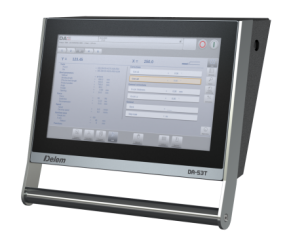
The CNC control system affects programming, operator training, setup time and production repeatability. Buyers should compare the control system’s interface, language options, tooling management, angle correction and data transfer functions. The PDS-110/4100 is equipped with a DELEM DA53TX CNC system. The technical specification lists the following functions:
● 15.6-inch TFT touch display;
● Multiple language options;
● Digital touch programming;
● Digital tooling programming;
● Automatic angle-correction database;
● Self-learning bending allowance tables;
● USB and RS232 interfaces;
● Error-warning system;
● Working-time and bending-cycle counters;
● Embedded file management;
● Machine analysis software for real-time monitoring;
● Optional 2D graphic programming;
● Capability to control up to six axes according to the system configuration.
Before placing an order, buyers should confirm which functions are included as standard and which are optional for the exact machine configuration.
8. Review Accuracy Specifications Carefully
Accuracy figures should always be read together with their definitions and testing conditions. A supplier should clarify whether a stated value applies to positioning, repeatability, synchronization or the finished workpiece. The documented accuracy specifications for the PDS-110/4100 include:
| Item | Specification |
| Slide positioning accuracy | ±0.02 mm |
| Slide repeatability | ±0.01 mm |
| Back gauge repeatability | ≤ ±0.02 mm |
| Displacement sensor resolution | 5 μm |
| Workpiece straightness | 0.3/m |
| Slide stroke | 215 mm |
| Die height | 535 mm |
| Throat depth | 400 mm |
The technical plan also states that the electro-hydraulic servo system maintains slide synchronization accuracy of ≤±0.02 mm. Buyers should ask the supplier to include the agreed accuracy definitions and acceptance method in the final order specification.
9. Do Not Overlook Tooling
Tooling affects the range of bends that can be produced, setup time and operator efficiency. The PDS catalog shows standard punch and die combinations, including segmented punch sections and die options.
The catalog describes a multifunctional quick clamp as a standard configuration. The quick clamp is designed to support faster tool loading and unloading and reduce manual handling during setup.
When choosing a press brake, confirm:
● Standard punch and die types;
● Tooling material and dimensions;
● Whether segmented tooling is included;
● Quick-clamp compatibility;
● Special punch and die options;
● Tooling requirements for the buyer’s actual drawings.
10. Confirm Installation, Training and Warranty
A press brake is a production system, not only a machine delivered to a factory. Installation, commissioning, operator training and technical support should be included in the purchasing evaluation.
According to the PDS-110/4100 technical plan, DARDON provides:
● Foundation drawings from the supplier;
● On-site installation and commissioning, with customer cooperation;
● Free training and technical consultation for the customer’s relevant personnel;
● Joint acceptance after installation and commissioning;
● A one-year quality guarantee from the date the machine arrives;
● Free replacement of parts damaged for reasons not caused by the user during the warranty period, excluding wearing parts;
● Lifelong maintenance service after the warranty period, with applicable service costs;
● A stated response time of two hours after receiving a quality report and on-site repair within 48 hours.
Buyers should still review the final warranty scope, wearing-parts list, installation responsibilities and response conditions in the signed technical agreement.
A Practical CNC Press Brake Selection Checklist
Before requesting a quotation, prepare the following information:
1. Required bending force;
2. Required bending length;
3. Workpiece drawings and dimensions;
4. Required number of CNC axes;
5. Preferred back gauge configuration;
6. Required accuracy and acceptance method;
7. Tooling requirements;
8. Workshop dimensions and power supply;
9. Installation and lifting conditions;
10. Training, warranty and after-sales requirements.
The PDS-110/4100 is specified for a 1100 kN nominal pressure, a 4100 mm bending length and a standard 4+1-axis configuration. Whether it is the right machine depends on the buyer’s drawings, process requirements, tooling plan and installation conditions.
Frequently Asked Questions
What does PDS-110/4100 mean?
PDS-110/4100 is the documented model designation. The technical plan specifies a nominal pressure of 1100 kN and a bending length of 4100 mm.
How many axes does the PDS-110/4100 have?
The standard configuration is 4+1 axes. The PDS series can also be configured with 6+1 or 8+1 axes according to the technical requirements.
Which CNC system is used on the PDS-110/4100?
The technical plan specifies a DELEM DA53TX CNC system from the Netherlands.
Does the machine use a servo-hydraulic system?
Yes. The PDS-110/4100 is described as a hybrid electro-hydraulic CNC press brake using a servo motor as the main power source for the hydraulic pump.
What is the slide positioning accuracy?
The documented slide positioning accuracy is ±0.02 mm, and the slide repeatability is ±0.01 mm.
Is quick clamping included?
The PDS catalog describes a multifunctional quick clamp as a standard configuration. The exact tooling package should be confirmed in the final order agreement.
What information should I provide when requesting a quotation?
Provide the required bending force, bending length, workpiece drawings, required accuracy, axis configuration, tooling requirements and workshop conditions. These details allow the supplier to recommend and confirm the correct machine configuration.
Request Technical Information
To discuss the PDS-110/4100 CNC press brake, contact DARDON:
● Email: [email protected]
● Phone: +86-532 88138811
● Website: https://www.chinadadong.com/
When contacting the supplier, include your workpiece drawings, required bending length, target accuracy, preferred axis configuration and tooling requirements so the machine configuration can be reviewed accurately.